
Pediatric hearing loss affects 1 to 3 per 1000 children, and early identification of this condition is essential for your child’s development. Hearing loss screenings and treatment can improve your child’s speech, language and social development. At ENT for Children, we offer several hearing tests and will work with your family to determine which one will be best for your child.
Audiogram (Behavioral Testing)
ENT for Children may recommend a hearing test or an audiogram for your child. All children who are being evaluated and have a history of ear infections undergo hearing testing.
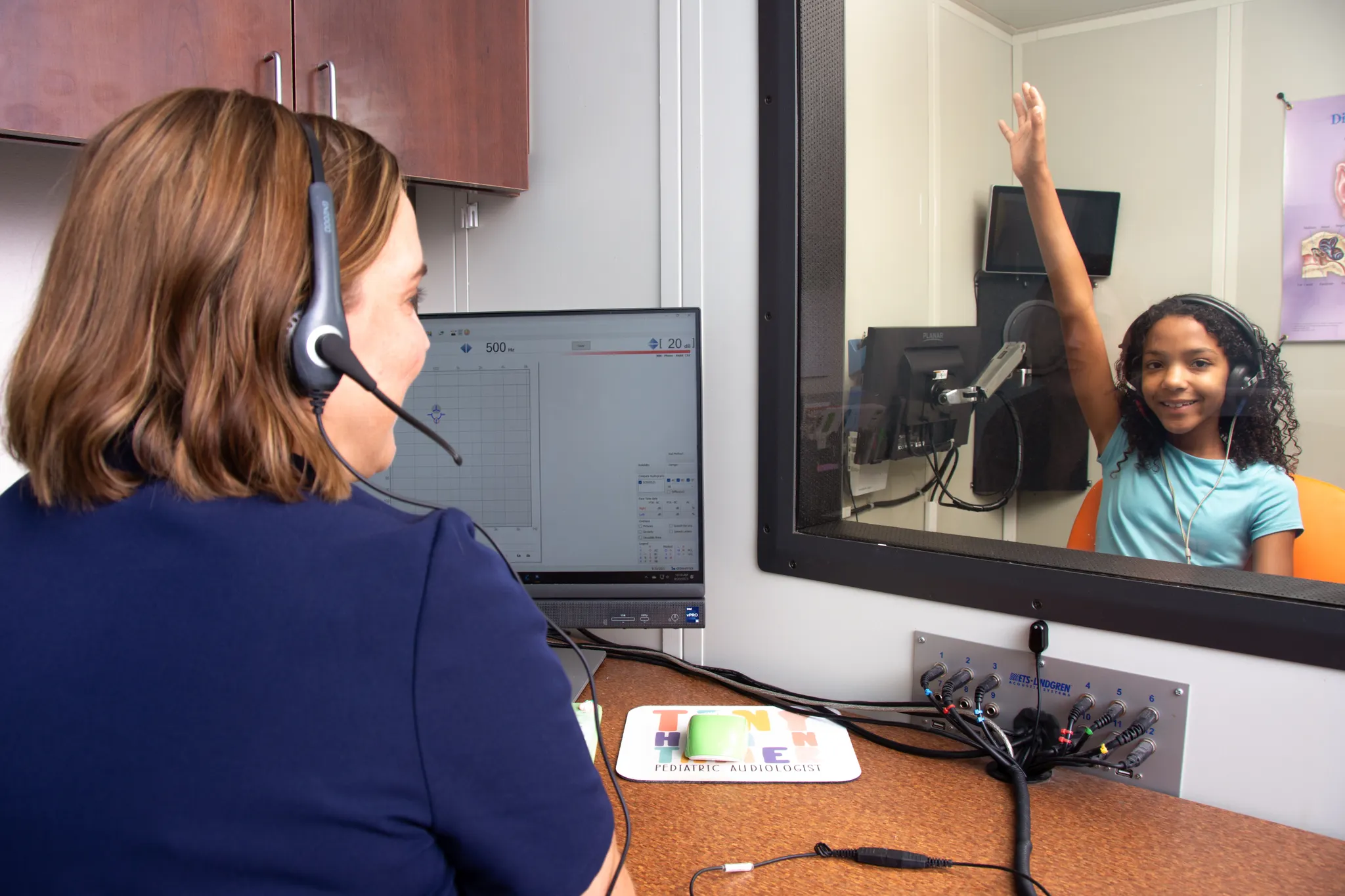
An audiogram is a formal hearing test that determines the type and degree of your child’s hearing impairment. Hearing tests are completed in a soundproof booth on children down to the age of 6 months. The type of hearing test that will be administered to your child is based on your child’s age.
- Visual Reinforcement Audiometry: This hearing test is completed on infants and young children. Typically, the Audiologist will have your child sit on your lap during testing. During this test, your child’s Audiologist trains your child to turn their head towards the sounds. Their behaviors are reinforced by characters in the speakers that light up and move when your child turns their head to the sound to reward them for responding.
- Conditioned Play Audiometry: This type of hearing testing is completed on older children. During this test, your child’s audiologists may play a game, such as dropping blocks in a bucket or putting pegs in a board, when they hear the sounds.
By the age of 5 or older, many children can complete a standard hearing test in which they raise their hand or say “yes” in response to different tones.
Tympanogram
Tympanometry is a test that is used to examine the condition of a child’s eardrum and middle ear pressure. During the test, your child’s audiologist gently places a probe in their ear canal. The device will change the air pressure in the ear canal to measure the motion of your child’s eardrum and the volume of their ear canal. The reading will be displayed on a graph or tympanogram. The results of this test may suggest whether there is fluid behind the eardrum, perforation of the eardrum or if ear tubes are open and working correctly. This is not a hearing test. This test does not hurt, but some children do not like anything placed in their ears. This testing can be used for children of all ages.
Two Audiologist Audiograms
To put your child at ease, another audiologist might accompany your child’s audiologist during their audiogram. Typically, one of the audiologists is inside the sound booth with your child, and a second audiologist runs the audiometer outside the sound booth. Both audiologists are working together to obtain a hearing test for your child. This type of testing is often recommended to get more ear-specific information about your child’s hearing at younger ages than might be possible with one audiologist completing a hearing test.
Otoacoustic Emissions (OAE)
This test assesses the function of your child’s microscopic hair cells in their inner ear (the cochlea). A probe is gently placed into your child’s ear canal. The probe makes a soft sound, and a super-sensitive microphone within the probe can hear or detect the motion of the hair cells in your child’s cochlea. The child must be still and quiet for testing. This test does not hurt or cause any pain and can take as little as 2-3 minutes to complete if your child is still and quiet.
Auditory Brainstem Response (ABR)
An auditory brainstem response (ABR) test can be performed on newborns, infants, young children, and any child who is difficult to test. An ABR test measures the electrical activity of your child’s inner ear, the nerve that connects the inner ear to the brain and the first part of the brain known as the brainstem. Your child’s audiologist at ENT for Children can interpret the tracings created by an ABR to establish at what level your child’s infant or child should be able to hear.
To complete an ABR, the audiologist will place stickers on your child’s forehead and behind the ear and a soft probe in their ear canal. The stickers are sensors that detect the electrical activity of your child’s ear. The Audiologist can deliver a series of clicking sounds or tones through the probe. Different loudness levels and pitches are tested to determine the softest level that is audible to your child.
If your child will allow the stickers to stay on their forehead and behind the ear and the probe to remain in the ear canal, then the ABR can be completed awake (un-sedated). If not, then completing an ABR will require anesthesia (sedation). We can schedule an un-sedated ABR at our Coppell or Southlake office. A sedated ABR is conducted under anesthesia at one of the surgery centers or hospitals where our physicians work.
If your child’s ABR is being completed un-sedated, plan that the test will take a minimum of 45 minutes but can take longer. Testing is dependent on the child’s cooperation and the amount of information being obtained.
Call ENT for Children for more information or to schedule an appointment.